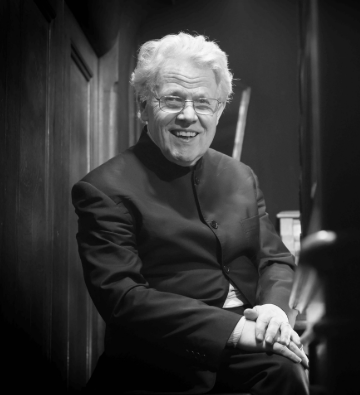
Daniel Roth, widely acclaimed as one of the leading French organ virtuosos, has held several prestigious positions as both performer and teacher. At the age of twenty he made his debut at the organ of the Basilique du Sacré-Coeur in Montmartre-Paris, as assistant of his teacher, Madame Rolande Falcinelli. He later succeeded her as titular organist, a post which he held until 1985 when he was appointed titular organist at St-Sulpice, the famous Paris church where his predecessors were Charles-Marie Widor, Marcel Dupré and Jean-Jacques Grunenwald. In 2023, he was appointed "Titulaire Emérite", in which capacity he plays the organ during Sunday or feast-day mass, the concert once a month and also for occasional services.
A former student at the Paris Conservatory, Daniel Roth's teachers have included Marie-Claire Alain and Maurice Duruflé. He has won several competitions, among them the Grand Prix de Chartres in 1971 for interpretation and improvisation.
After holding teaching positions at the Conservatories of Marseille and Strasbourg and at the Saarbrücken Musikhochschule, he was Professor of organ at the Musikhochschule in Frankfurt am Main from 1995 to 2007. Daniel Roth has been also Artist-in-Residence at the National Shrine of the Immaculate Conception and chairman of the organ department at Catholic University in Washington DC.
He is invited to play concerts as a soloist and with famous orchestras. Furthermore he teaches masterclasses and participates on juries for organ competitions throughout the world. On 11 November 2005 he played the dedication of the new Karl Schuke (Berlin) Organ of the "Grand Duchesse Joséphine-Charlotte" Concert Hall in Luxembourg, in the construction of which he was been artistic advisor.
A composer as well as performer, Daniel Roth has several works for organ, for flute and organ, and choir and organ. The City of Ludwigshafen (Germany) commissionned from him an orchestral piece, Licht im Dunkel, first performed in this town in May 2005 and in the church of St Etienne du Mont in Paris in April 2006 conducted by his son François-Xavier Roth. The work, published by Schott, has since become a triptych with movements entitled L'espérance, L'Amour and La Joie. For his compositions he received the Florent Schmitt prize awarded by the Académie des Beaux-Arts (Institut de France).
Daniel Roth is also well known for his brilliant improvisations which are regularly included in his concerts programs. He has many acclaimed recordings to his credit, covering pieces from the seventeenth century to the present time.
He is Chevalier de la Légion d’Honneur, Officier des Arts et Lettres, and Honorary Fellow of the Royal College of Organists; and in 2020 he received the RCO Medal (London). In 2006 he received the European Prize of European sacred music from the Schwäbisch Gmünd Festival (Germany). He is Member of Honor of the German Society of Organ Friends. He was awarded the Albert Schweitzer Grand Cross for services to Art during the European Organ Academy in Königsfeld, Germany, in 2009.
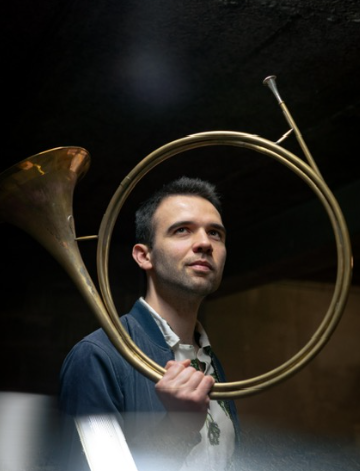
Félix Roth, born in 1997 in Paris, is a musician who is both a composer and a horn player. After studying horn and harmony at the Conservatoire de Paris (CNSMDP), he turned to composition, which he studied at the CRR in Boulogne-Billancourt with Jean-Luc Hervé before joining Frédéric Durieux's instrumental composition class and the new technologies applied to composition class with Yan Maresz and Luis Naón. He is fascinated by the phenomena of sound perception and the exploration of new harmonic paths. His first works were performed by the Ensemble Intercontemporain, the Ensemble TM+ and the NEXT ensemble.
Johann Sebastian Bach (1685-1750)
Fantasia & Fugue in G minor, BWV 542
Ludwig van Beethoven (1770-1827)
Adagio, from the Sonata Pathétique (transcription by F. Brémond)
César Franck (1822-1890)
Andantino in G minor
Emmanuel Chabrier (1841-1894)
Larghetto for horn and orchestra
Charles-Marie Widor (1844-1937)
Allegro, from Symphony no. 7
Olivier Messiaen (1908-1992)
Appel interstellaire, from Des Canyons aux Etoiles
Maurice Duruflé (1902-1986)
Choral varié sur Veni Creator
Paul Dukas (1865-1935)
Villanelle for horn and orchestra